
Nevada: the real richness of the ‘Silver State’
 18 December 2025
 Associating Las Vegas with a land which encompasses hidden natural and cultural treasures, is not a simple and obvious consideration. In fact, Las Vegas is not only a leisure destination, the ‘Capital City of entertainment’, or the so-called ‘Sin City’, as the Tourism Industry commonly promotes it.
Las Vegas hinterland and the State of Nevada itself, are resourceful places with much more to discover than Casinos and nightlife entertainment. For instance, the Valley of Fire State Park (1934) is Nevada’s first National Park, renowned and protected for its exceptional scenic, archaeological, and geological beauty.
The richness of its landscape is combined with cultural and ecological aspects, presenting the State of Nevada as a territory dedicated to ecotourism, beyond leisure expectations. The endemic nature includes typical plants and animals of the area like, for example, the iconic ‘Bighorn Sheep’ or ‘Rocky Mountain Sheep’.
Also, it is a destination dedicated to local indigenous culture and a precious historical, ethnographic and eco-cultural heritage to preserve. In Nevada live four main groups of indigenous people who are settled in different areas of the ‘Silver State’.
One of these is the ‘Southern Paiute’ tribe (1110-1850 AD), who is divided into three tribal subgroups who live in southern Nevada, in the area surrounding Las Vegas and the Valley of Fire State Park, formerly occupied by the ancestral ‘Anasazi’ tribe (500-1150 AD).
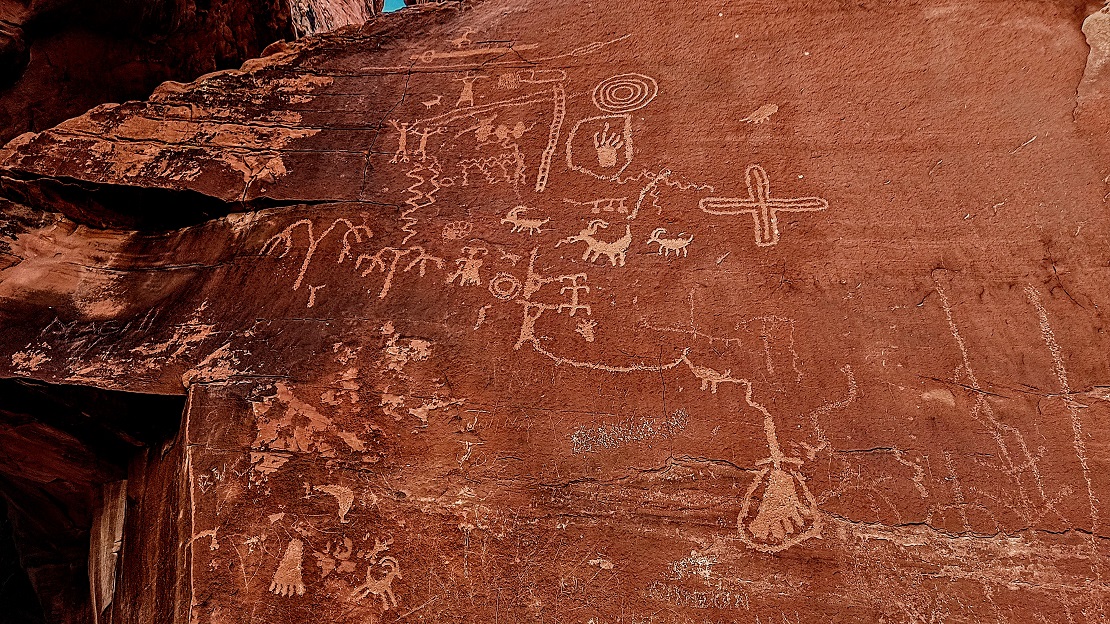
This U.S National Park, with its red rocks and marvelous golden streaks, was formed 150 million years ago. Here, you can see magnificent petroglyphs carved and painted on the rocks. It is a primitive and ancestral archaeology, a real type of ‘Rock Art’ with powerful symbols of culture, history, spiritualism and mythology.